

ABOUT THE PROJECT
Migration, Adaptation, Innovation:
1500-1800
Overview
The Research
Key Findings
Impact
Partners and Advisory Board
Overview
Migration, Adaptation, Innovation: 1500–1800 is a UKRI Future Leaders Fellowship project (£1.2m) led by Dr Felicia Gottmann, Associate Professor at Northumbria University, running in its initial phase from 2021 to 2027. Combining economic history, science and technology studies, material culture, and migration studies, it offers the first globally comparative and non-Eurocentric study of how skilled migration drove technological innovation in the early modern world.

Bowing Cotton in India. Textile technologies are one of the project’s focus areas. Watercolour ca 1800? Wellcome Library no. 576236i. Public Domain Mark
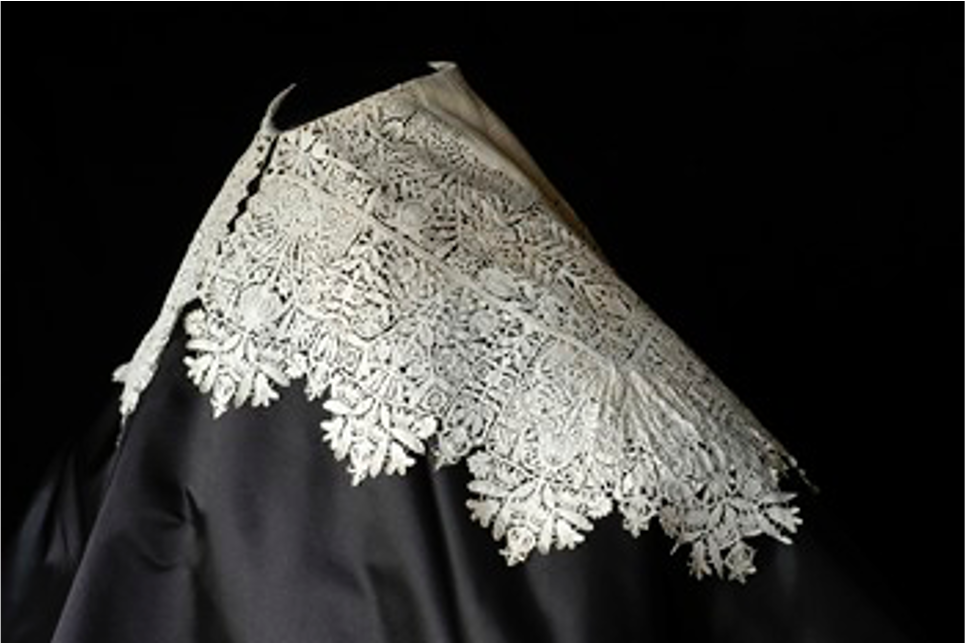
This early seventeenth-century man’s cloak band, made out of linen cutwork and geometric lace, is held by our partner, The Bowes Museum, as part of the Blackborne Collection.

Ceramics are one of the project's focus areas. This late 17th-century Japanese Arita blue and white porcelain jar is held by our partner museum, the Durham Oriental Museum: DUROM.2006.75. Bequeathed by Dr H. Muir.
The Research
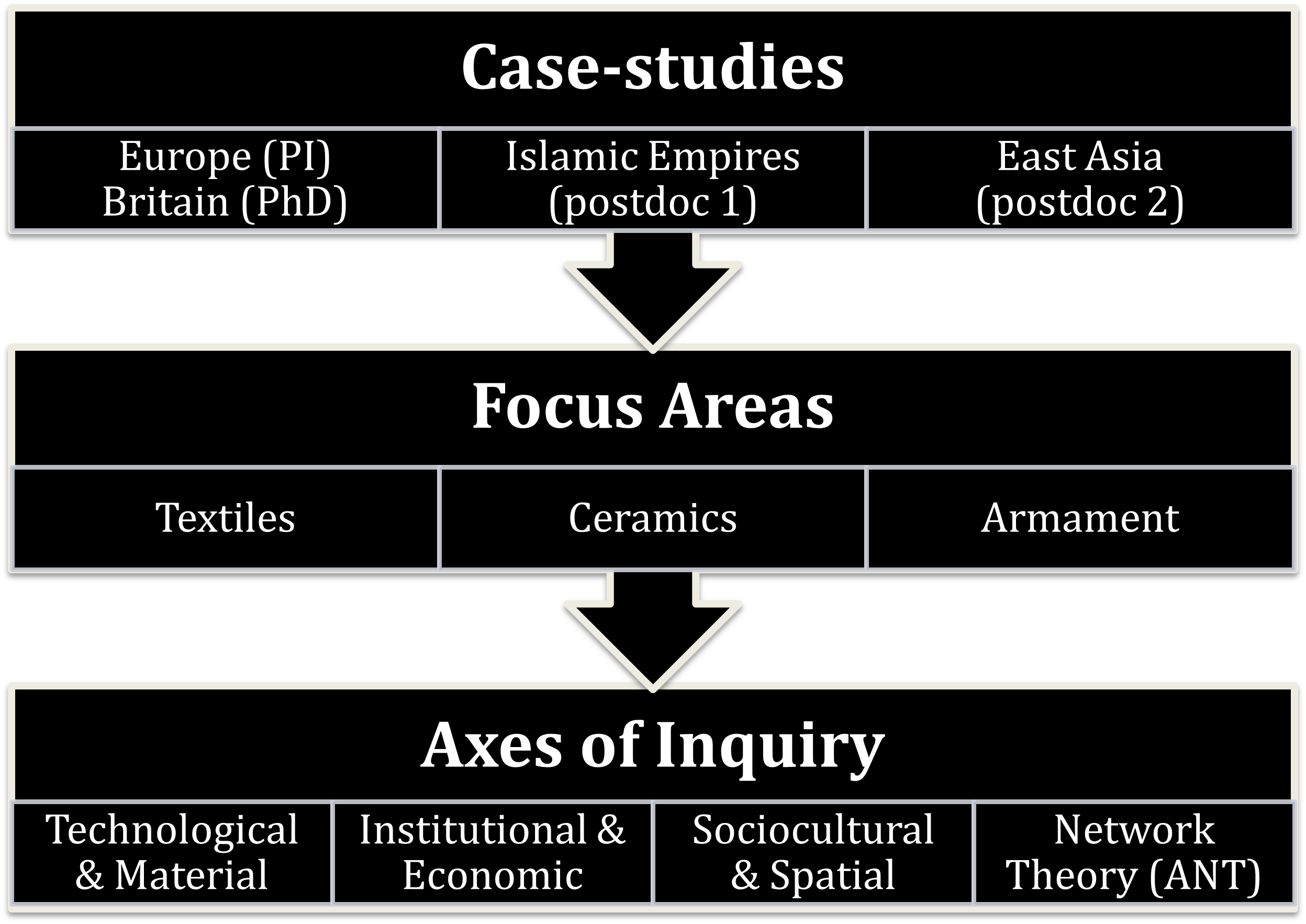
After three broad regional surveys, our team conducted three parallel regional studies across 1500–1800, each investigating how skilled migration was linked to technological change:After three broad regional surveys, our team conducted three parallel regional studies across 1500–1800, each investigating how skilled migration was linked to technological change:
Three Regional Case Studies
Europe and its Colonies: PI: Dr Felicia Gottmann, Northumbria University and Great Britain (PhD case study):Oliver Gunning — viva passed January 2026
The Islamic World: Postdoc: Dr Rémi Dewière (now Lecturer, Università degli Studi di Padova
The Sinosphere (East and Southeast Asia): Postdoc: Dr Floris van Swet
Three Focus Areas
The project focuses on the most innovative industries of the period, all characterised by high levels of skilled labour, state sponsorship, and global knowledge exchange:
Textiles
Ceramics
Firearms Technology, (including the requisite Mining and Gunpowder Technologies)
Four Axes of Inquiry
Across all three regions and industries, we investigate the same four sets of factors, allowing for genuine cross-regional and cross-temporal comparison:
Technological and Material
Institutional and Economic
Sociocultural and Spatial
Actor Networks (ANT)
Key Findings
Our research, published jointly and individually (see outputs), shows that skilled migration was neither exclusively Western nor exclusively modern — it was a global engine of technological change across the premodern world. Four findings stand out:
Political support was necessary — but not sufficient
Across all three regions, rulers actively recruited skilled migrants. But political backing alone did not guarantee success: suitable materials, a host workforce with some pre-existing craft knowledge, and an open society were equally important.
The importance of a shared craft culture
Innovation required a basic shared technological language between migrant and host. Without a minimum of common craft knowledge, skills transfer and collaboration simply could not happen.
Soft skills mattered as much as technical mastery.
Adaptability, diplomacy, and political nous were as important as craft competence. For knowledge to cross cultural boundaries, genuine inter-personal exchange was indispensable.
Europe’s advantage was not migration management per se.
Every region practised this. What for ultimately distinguished Europe’s ‘Great Divergence’ was the interplay of state backing, transnational capital flows, and skilled migration working together — the subject of the PI’s forthcoming monographs.

Armament is one of the project's focus areas. This nineteenth-century Indian watercolour gives an insight into the global adoption and adaptation of firearms. Wellcome Library no. 576313i

Ceramics are one of the project's focus areas. This pen and ink drawing shows potters at work in China. Wellcome Library no. 567857i. Public Domain
Impact & Engagement
Just as our research is non-hierarchical and non-Eurocentric, our impact and engagement work is similarly rooted in the principal of equal partnerships, genuine collaboration and exchange.
Our findings have two clear contemporary messages: inclusion and recognition are as crucial to a migrant’s success today as they were in the early modern world; and migration, connection and exchange have shaped the past just as much as they do the present: history has never just been regional or national. This matters, especially in a region like the North East of England that is both economically-deprived and has one of the highest per capita rates of resettled refugees and asylum seekers. By highlighting the historic connectedness of a region that perceives itself as isolated and left behind, we can empower multiple generations to think of themselves as stakeholders in a wider, more global context.
Working directly with migrants
A series of participant-led workshops at the Shipley Gallery in Gateshead, as a triple collaboration between the Shipley Gallery, Multaka North East England, and the Migration-Innovation Project, gave recent migrants to the UK a space to reflect on and celebrate the skills they bring to their new home. The themes and format are now embedded in the gallery’s permanent programme. Our collaboration with TOP, the Other Perspective, also led directly to Northumbria University’s establishing a working group to work towards an application to join the University of Sanctuary network.
Working with educators
Over four day-long training sessions at the Oriental Museum in Durham, we worked with nearly 300 PGCE and BA Education students, developing an object-centred approach to teaching migration, cultural diversity, and inclusion. Participants felt equipped to create more inclusive classrooms. We have also run hands-on workshops with primary school children at Hotspur School in Newcastle, and are developing new resources with the Auckland Project and Ushaw Historic House and Gardens.
Collaborating with museums and heritage institutions
Our international conference at the German Museum of Technology in Berlin brought together historians, economists, anthropologists, STS scholars, museum professionals, and community workers, seeding new partnerships across Europe. We have delivered public lectures and workshops at the Bowes Museum, staff and volunteer training at the Auckland Project, and are preparing an exhibition and schools resources together with Ushaw Historic House and Gardens.
Partners & Advisory Board
Museum and Heritage Partners
The Auckland Project, Bishop Auckland
The Bowes Museum, Barnard Castle
Deutsches Technikmuseum (The German Museum of Technology), Berlin
North East Museums/ The Shipley Gallery, Gateshead
The Oriental Museum, Durham
Ushaw Historic House and Gardens, Durham
Academic Advisory Board
Julia Adams — Professor of Sociology and International and Area Studies, Co-Director CHESS, Yale University
Giorgio Riello — Chair of Early Modern Global History, European University Institute, Florence
Dagmar Schäfer — Director, Max Planck Institute for the History of Science, Berlin
Simon Schaffer — FBA, Professor of History of Science, University of Cambridge
For more details on our activities visit our Blog.
For a full list of publications, visit our Outputs page.